
Romelu Lukaku does not tiptoe into matches;he announces himself with a thunderous sprint and a shoulder that sends defenders stumbling. Watching him live for the first time, you notice the sheer physics of the man—six feet three, nearly two hundred pounds, yet moving with the acceleration of a winger. That contradiction is the heart of his game. Pure power, yes, but a touch that has grown increasingly refined。and a tactical intelligence that often goes unappreciated. When he received the ball with his back to goal against Atalanta last season, he didn't just hold it up—he pivoted, dragged two markers with him, and slipped a pass into the channel that split the defense open. That is not the work of a simple target man. That is a striker who has evolved.Critics love to point at his first touch or his record in big finals, yet they rarely mention the sheer volume of chances he creates for others. During his second spell at Inter, Lukaku averaged 2.3 key passes per ninety minutes in Serie A—a figure that rivals many attacking midfielders. His partnership with Lautaro Martínez was not just about goals;
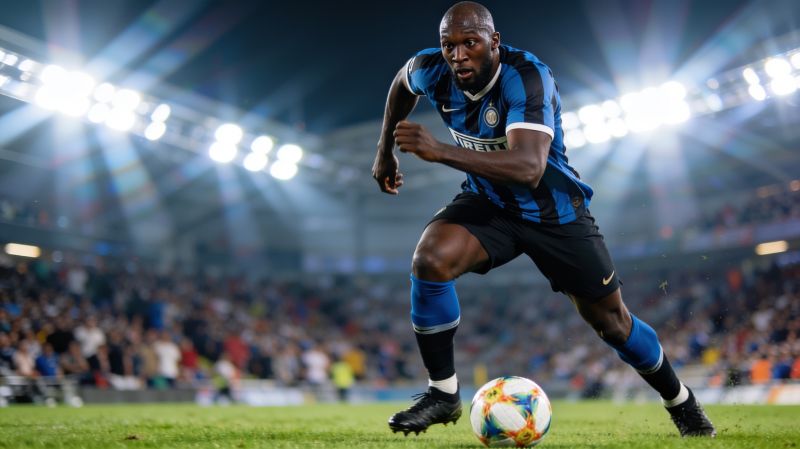
it was about movement。about occupying center-backs so that Lautaro could drift into pockets of space. You could see it in the way Lukaku would deliberately drag the left-sided center-back toward the touchline, leaving a canyon for his teammate to exploit. These are the details that statistics sometimes miss: the gravitational pull of a striker who commands attention even when he is not scoring.There is a raw honesty to Lukaku's style that I find refreshing. He doesn't pretend to be a false nine or a tiki-taka merchant. He runs in behind with the directness of a freight train, and when he gets the ball on the half-turn, he drives at defenders like a man with a grudge. I remember watching him for Everton against Chelsea at Stamford Bridge—he held the ball up for what felt like ten seconds, swatting away N'Golo Kanté with one arm, then spun and fired a low shot that forced a save. It was brutal, efficient, and somehow beautiful in its simplicity. That is the essence of Lukaku: no frills。but a devastating effect.His return to Chelsea, however, exposed a different truth. The system did not suit him. Thomas Tuchel's intricate possession game asked Lukaku to link play in tight spaces, to be a cog in a machine rather than the engine itself. The result was a frustrating season, and the narrative quickly turned against him. Yet I would argue that the fault lay less with Lukaku's ability and more with the tactical mismatch. At Inter, Antonio Conte built a team around his strengths—quick transitions。
early crosses, and two strikers who complemented each other. When Lukaku is used correctly, he is nearly unplayable. The lesson is not that he is limited;it is that the modern game demands flexibility, and Lukaku's best self emerges when a manager embraces his direct, physical approach rather than forcing him into a possession-based straitjacket.Now, as he enters the later stages of his career, the question is whether Lukaku can adapt one final time. His physique will not last forever, but his football brain is sharper than ever. I have seen him drop deeper to receive the ball, almost like a playmaking forward, and his leadership in the Belgium dressing room has grown undeniable. There is a quiet intensity to him that I admire—a refusal to be defined by a single missed chance or a costly error. He keeps running, keeps demanding the ball, keeps scoring. For all the debate about what he is not, Lukaku remains a colossal figure in the modern game. A striker of his caliber, with his blend of power, pace。
and presence, is rare. And when the ball hits the net, the noise is always the same: a roar that acknowledges an unstoppable force.